Many companies are investing in AI while their core systems still struggle to communicate with one another. As AI becomes part of everyday operations, fragmented data and manual workflows are no longer minor technical inconveniences. They are becoming one of the main reasons why promising AI initiatives fail to create lasting value.
A familiar conversation is taking place inside companies today. Leadership teams want to know how AI can improve productivity, reduce repetitive work, and create better customer experiences. They are discussing AI assistants for sales teams, automated support workflows, internal knowledge tools, and new ways to analyze operational data.
These are reasonable ambitions. In many cases, they are also necessary. AI is already changing how companies think about work, and ignoring it entirely is not a realistic option. But many organizations begin with the wrong question. They ask which AI tool they should adopt, which model they should use, or which process they should automate first.
A more important question often remains unanswered:
Can the company’s existing systems support this kind of automation in the first place?
For many organizations, the honest answer is: not yet.
The issue is rarely a lack of software. Most growing companies already use a wide range of tools. Customer data sits in one platform, employee records sit in another, and financial information is stored somewhere else. Operational knowledge may still live in spreadsheets, internal documents, and email threads.
Individually, these systems may work well. Collectively, they often create a fragmented operating environment. That fragmentation was manageable when people were responsible for connecting the dots manually. It becomes a much bigger problem when companies expect AI to do the same work automatically.
AI is often presented as a shortcut to greater efficiency. In practice, it behaves more like a stress test. It reveals where information is incomplete, where processes rely on personal knowledge, and where systems were never designed to work together.
Imagine asking an AI assistant a simple business question:
“Which customers are most profitable, and where do we have the greatest opportunity to improve retention?”
A useful answer may require access to CRM data, billing records, product usage, support history, and marketing analytics. If those systems are not connected, the problem is not the intelligence of the model. The problem is the absence of a reliable information flow.
The same issue becomes even more visible when companies move from AI assistants to AI agents. An assistant may summarize a document or draft an email. An agent is expected to take action. It may need to update a record, trigger a workflow, check permissions, and retrieve information from several systems before it can complete a task.
That is where many pilots begin to struggle. The model may be capable, but the surrounding infrastructure is not.
Software stacks tend to grow gradually. A new tool is introduced to solve a specific problem. Another platform is added when a team expands. A legacy system remains in place because replacing it would be expensive or risky.
Over time, the company ends up with a collection of useful tools that were never designed as one coherent ecosystem.
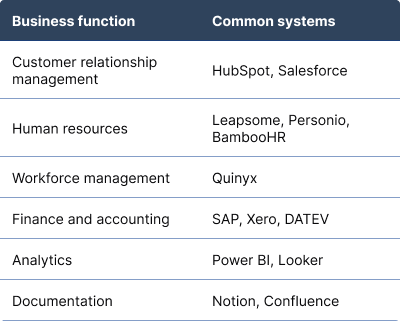
There is nothing inherently wrong with this setup. The problem begins when important processes depend on people moving information between systems manually. A team member exports a CSV file, someone else copies the data into a spreadsheet, and a manager updates the same information in two different platforms. A colleague knows which number is correct because they have been working with the process for years.
These workarounds may feel harmless at first. As the company grows, they become a hidden operational cost. They also create a weak foundation for AI because automated systems cannot rely on informal knowledge or undocumented habits.
We encountered this challenge while working with BEAT81. The company needed employee information to move reliably between two systems. Leapsome was used for employee-related events, including onboarding, profile updates, and offboarding, while Quinyx was used for workforce management.
The business need was easy to understand. When employee information changed in one system, the relevant data had to be reflected in the other system as well. Without an integration layer, this process depended on manual coordination, which created additional administrative work and increased the risk of inconsistent records.
The solution was a lightweight integration service. When an employee-related event occurs in Leapsome, a webhook sends the relevant information to the integration layer. The service maps the data and updates Quinyx through its SOAP API.
The technical implementation included webhooks, authentication, data mapping, and API communication. The business impact was simpler to explain: employee information could move between systems more reliably, administrative work was reduced, and records remained more consistent as the company continued to scale.
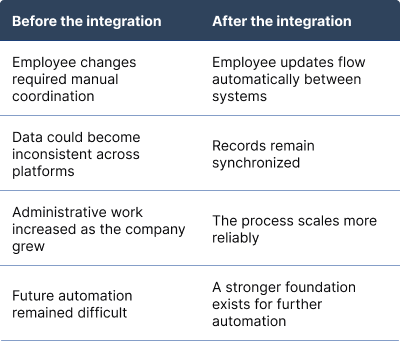
This was not an AI project. But it illustrates something important about AI adoption. Before companies can automate complex workflows, they need to make sure that the underlying systems can communicate reliably. Otherwise, AI is introduced on top of processes that were already fragile.
Integrations are not new. Companies have been connecting software systems for decades. What is changing is the role integrations play in business strategy.
In the past, a missing integration usually created inconvenience. Someone had to enter data manually, export a file, or check two platforms instead of one. Today, the consequences are more serious because companies increasingly expect software systems to support automation, real-time decision-making, and AI-powered workflows.
If a company wants to introduce AI into its operations, information must be accessible, consistent, and trustworthy. Automated workflows cannot depend on undocumented shortcuts or personal knowledge stored in someone’s head. They also cannot rely on data that becomes outdated every time one system changes and another does not.
This changes how companies should think about their technology stack. Integrations are no longer a purely technical concern managed quietly in the background. They directly influence operational efficiency, data quality, and the company’s ability to use AI in a meaningful way.
The companies that benefit most from AI will not necessarily be the ones that adopt the newest tools first. They will be the ones that make their existing systems work better together.
Before launching another AI pilot, companies should take a closer look at the operating environment underneath it. The goal is not to postpone innovation. It is to understand whether the company has the foundation required to make that innovation useful.
It is easy to say that a company has customer data, employee data, or product data. It is more useful to understand where that information is stored, whether it is reliable, and whether different teams work with the same version of it. If several systems contain different answers to the same question, AI will not solve the problem automatically.
Manual work is not always a problem. Some workflows do not need to be automated. But when routine operations depend on copying data between systems, maintaining spreadsheets, and sending reminders internally, scaling becomes difficult. These are often the first places where integrations create immediate value.
Access to data is only one part of the equation. For AI agents to become useful in real operations, systems also need reliable APIs, clear permissions, and well-defined workflows. An agent that can read information but cannot safely update a record or trigger an action remains limited in practice.
These questions may sound less exciting than a new AI demo. But they often determine whether AI creates real value or remains another experiment that never becomes part of everyday work.
AI has created a new sense of urgency around digital transformation. That urgency can be useful because it forces companies to examine systems and processes they may have ignored for years. But AI should not be treated as a shortcut.
A chatbot will not fix fragmented operations. An AI agent will not resolve inconsistent data. A new platform will not remove the need for clear ownership and reliable processes. The more ambitious the AI use case, the more important the underlying infrastructure becomes.
This is why integration work deserves more attention. It may not be the most visible part of an AI strategy, and it may not be the part that generates the most excitement in a presentation. But it is often the part that determines whether AI becomes genuinely useful.
Before AI can transform a business, information needs to flow.

Senior product engineering, AI systems and embedded engineering teams from Berlin.


 EN
EN
 DE
DE