If you manage an engineering team today, you've probably heard the same debate more than once: should we use Cursor or Claude Code? At first glance, the two tools appear to solve the same problem. Both help developers write code faster, explore existing systems, and automate repetitive work. Both promise to reduce the time between an idea and a working implementation. But treating them as direct competitors is often the wrong way to think about them.
The real difference becomes visible when you look at the kind of work each tool is optimized for. Cursor is designed around the daily development workflow. It helps engineers move faster inside an environment that already feels familiar. Claude Code approaches the problem from a different angle: it becomes most valuable when understanding the system matters more than simply producing code quickly. The question is therefore not which tool is objectively better. The question is what kind of bottleneck your engineering organization is trying to remove.
Cursor became popular because it fits naturally into the way software engineers already work. Developers can stay inside a familiar editor, ask questions, generate code, create tests, refactor existing functionality, and continue building without changing their habits. That matters because the hardest part of introducing a new engineering tool is rarely its technical capability. The hardest part is adoption. A tool can be impressive in a demo and still fail inside a real team if using it creates additional friction.
Cursor avoids much of that resistance. For product teams that ship new functionality every week, the immediate value is easy to understand: less time spent writing repetitive code, fewer interruptions while searching for context, and faster iteration on well-defined tasks. It does not require the organization to redesign its development process before engineers can benefit from it. In many teams, that simplicity is the reason it creates value quickly.
This makes Cursor especially useful when the codebase is reasonably well understood and the priority is delivery speed. If engineers already know what needs to be built, where the change belongs, and how the surrounding system behaves, the main bottleneck is execution. Cursor helps remove that bottleneck by making everyday implementation work faster and more fluid.
Claude Code becomes more interesting when the bottleneck is not execution but understanding. In mature engineering organizations, generating code is often the easy part. The harder part is identifying what should be changed, what should remain untouched, and what hidden consequences a seemingly simple decision might create across the wider platform.
This is especially relevant in systems with years of accumulated technical debt, complex service dependencies, undocumented business rules, and architectural decisions that no single engineer fully understands anymore. In those environments, a senior developer may spend hours tracing data flows, checking how a business rule is enforced across multiple services, or trying to understand why a particular abstraction exists before writing a single line of code. Claude Code is useful because it supports that type of work. It is less about helping developers type faster and more about helping them reason through complexity.
The difference is important. Cursor is strongest when engineers already understand the path forward and want to move quickly. Claude Code becomes valuable when the path itself is unclear. It helps teams explore large systems, prepare risky refactors, investigate legacy code, and understand the implications of changes before they are introduced.
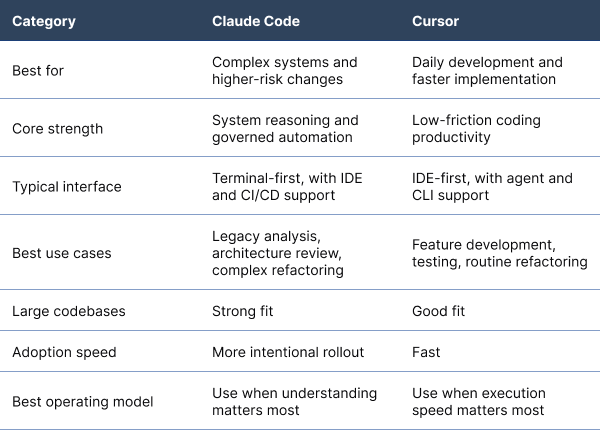
Most engineering leaders start by comparing features. Which tool has the better models? Which one works faster? Which one supports more integrations? These questions are understandable, but they are not the best place to begin. A feature comparison only becomes useful after the organization understands the problem it is trying to solve.
A startup with a relatively clean codebase and ten engineers has different needs than an enterprise platform with hundreds of services and years of technical debt. In the first case, faster implementation may create the biggest improvement. In the second, the real cost often comes from uncertainty: engineers are afraid to change parts of the system because they cannot clearly predict the impact. The tools may be the same, but the bottlenecks are completely different.
That is why two teams can evaluate Cursor and Claude Code and reach opposite conclusions without either of them being wrong. If the main challenge is delivery speed, Cursor is usually the more practical starting point. If the main challenge is system complexity, difficult refactors, legacy architecture, or fragmented technical knowledge, Claude Code may deliver more value. The best decision is not based on which tool looks more impressive. It is based on which constraint is currently slowing the team down.
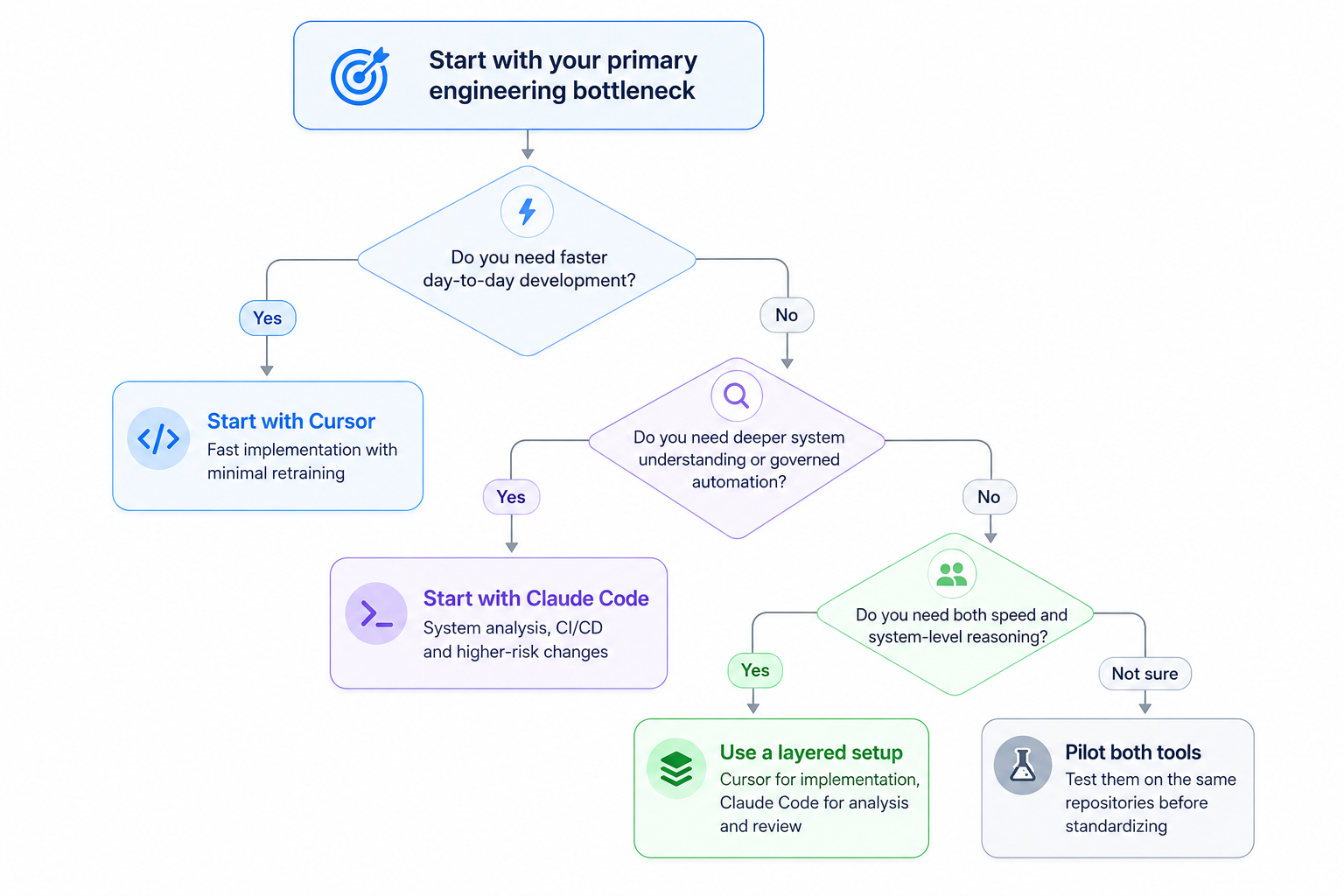
The most interesting outcome is that mature engineering teams often do not choose one tool and reject the other. They use both, because software development is not a single type of work. Building a new API endpoint is different from planning a major migration. Writing tests for a well-understood feature is different from untangling five years of technical debt. Reviewing a small pull request is different from assessing whether a refactor could break several interconnected services.
Cursor fits naturally into the high-frequency part of the workflow. It supports developers during everyday implementation, where speed, convenience, and short feedback loops matter most. Claude Code belongs in the parts of the process where context and reasoning matter more: architecture reviews, system analysis, difficult debugging sessions, refactoring preparation, and higher-risk engineering decisions.
This layered approach reflects how engineering teams already operate. Junior developers, senior engineers, staff engineers, and architects do not contribute in exactly the same way. Different responsibilities require different types of support. AI tools are beginning to follow the same logic. Instead of expecting one tool to perform every role equally well, organizations can assign each tool to the situations where it creates the most value.
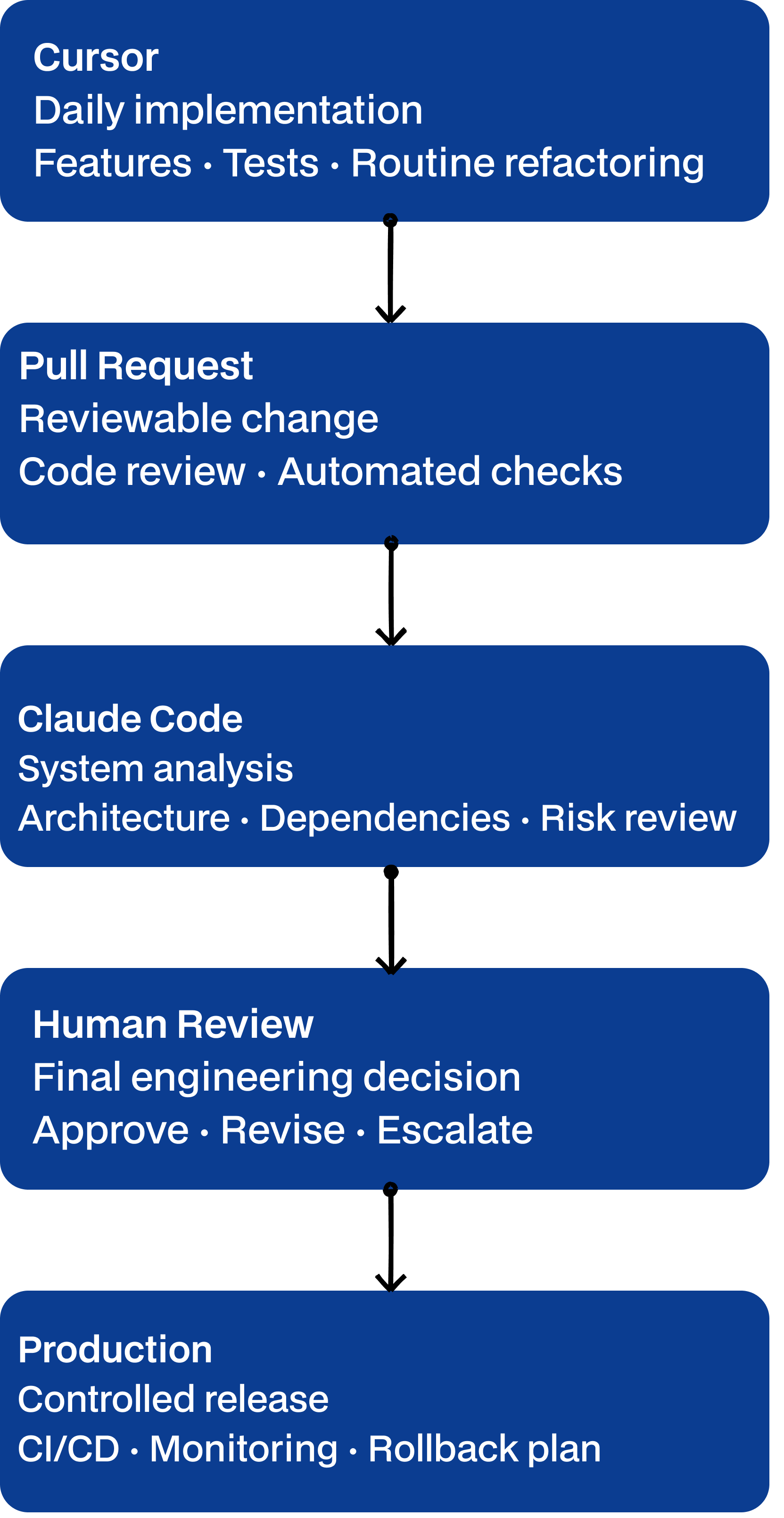
The Claude Code versus Cursor debate reveals something broader about AI adoption in engineering teams. Organizations that focus mainly on delivery speed tend to prioritize tools that make implementation faster. Organizations dealing with larger and more complex systems often care more about understanding, visibility, and risk reduction. Neither approach is wrong. They simply reflect different stages of engineering maturity and different types of operational pressure.
Cursor is one of the strongest tools available today for improving day-to-day developer productivity. Claude Code is one of the strongest tools available for understanding and evolving complex systems. For many teams, the most effective strategy is not choosing one tool over the other, but understanding where each belongs inside the development process.
The right question is not:
"Which AI coding tool should we standardize on?"
It is:
"Where can each tool create the most value for our engineering team?"


 EN
EN
 DE
DE